
Echoes of Kuweni: Unearthing Wilpattu's Ancient Royal Legacy
Beneath the canopy of Wilpattu's dry-zone forest, ancient stones whisper tales of Sri Lanka's foundational myths and enduring wilderness.
Governor's Camp Wilpattu
Master Naturalist Team
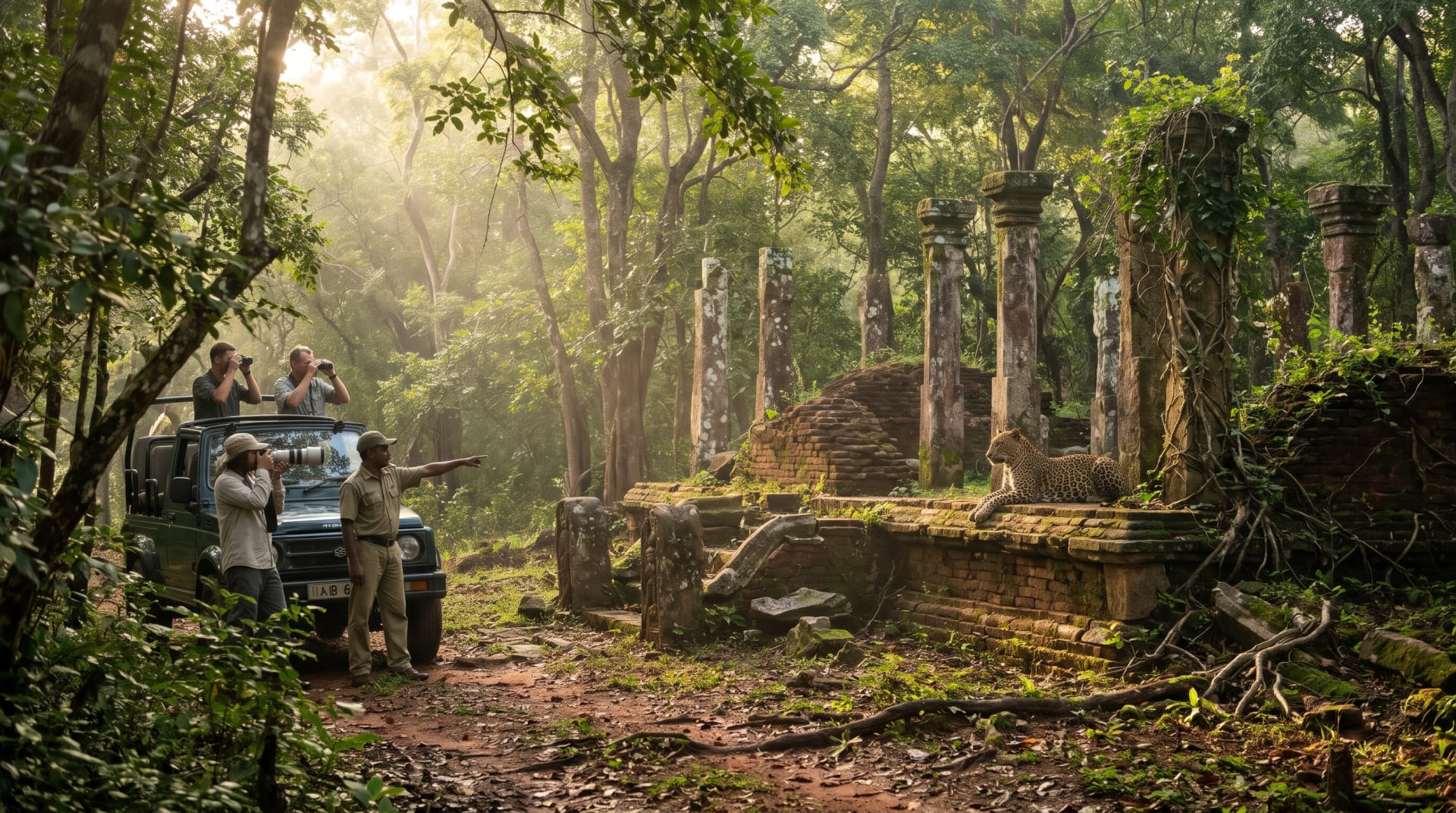
The early morning air in Wilpattu carries the sharp tang of wet red loam, a scent deepened by the overnight monsoon shower. As first light, around 06:15, filters through the dense canopy of Palu trees (Manilkara hexandra), it illuminates not only the dew-kissed leaves but also the weathered stones of forgotten civilisations. Wilpattu, Sri Lanka's largest national park, is renowned for its elusive Ceylon Leopard (Panthera pardus kotiya) and the serene expanse of its over 106 natural sand-rimmed rainwater lakes, or villus. Yet, beneath this vibrant ecological tapestry lies a deeper, human history, a chronicle etched in stone and myth. Our expeditions into Wilpattu often reveal more than just wildlife. They lead us to archaeological sites that speak of a profound human-wildlife interface, dating back millennia. These ancient ruins, often subtly reclaimed by the forest, are not mere historical footnotes; they are integral components of the park's unique biodiversity, offering shelter and vantage points for the very creatures that now roam these ancestral lands.
The Mythic Landscape: Tracing Queen Kuweni's Domain
The most evocative of Wilpattu's historical narratives is intrinsically linked to the legend of Queen Kuweni, the indigenous yakkhini queen, and Prince Vijaya, the progenitor of the Sinhalese nation. While specific sites associated directly with Kuweni are subject to archaeological debate, the broader region of Wilpattu, with its ancient settlements and irrigation systems, aligns with the historical and mythical geography of early Sri Lankan kingdoms. Exploring these sites requires keen observation, not just for archaeological fragments but for the subtle signs of the current inhabitants.
Our trackers, adept at reading the nuances of the dry-zone environment, often point out fresh pugmarks of a Ceylon Leopard (Panthera pardus kotiya) or the distinctive scat of a Sri Lankan Sloth Bear (Melursus ursinus inornatus) near ancient stupa mounds or collapsed stone structures. These ruins, now part of the forest floor, provide microhabitats and elevated perches, demonstrating how nature reclaims and integrates human endeavours. The metallic clinking call of a White-browed Fantail (Rhipidura aureola) echoing through a crumbling archway serves as a constant reminder of this enduring natural dominion.
Ancient human settlements within Wilpattu are not separate entities but have become integral components of the park's ecological framework, influencing wildlife behaviour and habitat use.
Conservation Biology and Archaeological Stewardship
The preservation of Wilpattu's archaeological heritage is inextricably linked to its conservation biology. Uncontrolled access or development poses a dual threat: to the fragile historical structures and to the sensitive ecosystems that have grown around them. Our approach at Governor's Camp Wilpattu emphasises minimal impact, ensuring that visits to sites like those near Maradanmaduwa Wila are conducted with the utmost respect for both cultural and natural integrity. This involves careful monitoring of human presence to prevent disturbance to critical wildlife corridors or nesting sites.
Field craft for observing wildlife near these sites demands patience and a deep understanding of animal behaviour. Trackers listen intently for the alarm barks of Barking Deer (Muntiacus muntjak) or the resonant calls of Grey Langurs (Semnopithecus priam thersites) which often indicate the presence of a predator, such as a Ceylon Leopard, using an ancient stone platform as a lookout. A 400mm+ telephoto lens, stabilised by a beanbag, is essential for capturing wildlife without encroaching upon their space or the delicate archaeological context.
Governor's Collection: A Journey Through Time and Wilderness
At Governor's Camp Wilpattu, our commitment extends beyond conventional safari experiences. We curate immersive journeys that weave together the park's profound natural beauty with its ancient human legacy. Guests access the park via the tranquil western Eluwankulama gate, bypassing crowds and immediately entering a realm where wildness and history coalesce. Our Master Naturalist Team guides these expeditions, providing context to both the elusive wildlife and the silent narratives of the past, ensuring an authentic and respectful encounter with Wilpattu's multifaceted heritage.
Evenings at our riverfront tented camp bordering Raalmadu Oya offer reflection on the day's discoveries. The low-frequency rumble of a distant Asian Elephant (Elephas maximus maximus) might carry on the thermal winds, a sound that has echoed across these villus for millennia, long before and after Queen Kuweni's legend took root. Our private jungle swimming pool offers a refreshing respite, while nocturnal guided river walks reveal the unseen world, a continuous thread connecting ancient past to living present.
Approach archaeological sites with the same reverence and quiet observation as a wildlife sighting, understanding their dual significance to both human history and current ecology.
Field Notes & Key Takeaways
- Optimal exploration of Wilpattu's archaeological sites is during first light (06:15–08:30) or late afternoon (15:45–18:15) for cooler temperatures and active wildlife.
- Look for animal signs like pugmarks, droppings, and alarm calls near ancient structures, indicating their integration into the current ecosystem.
- Utilise telephoto lenses (400mm+) and lens support to photograph wildlife and ruins respectfully, maintaining distance and minimising disturbance.
- Governor's Camp Wilpattu provides exclusive, crowd-free access via the Eluwankulama gate for a deeper, guided historical and wildlife immersion.
Frequently Asked Questions
Are there actual archaeological ruins within Wilpattu National Park?
Yes, Wilpattu National Park contains several significant archaeological sites, including ancient stupas, irrigation systems, and remnants of early settlements, some associated with the legend of Queen Kuweni and the earliest kingdoms of Sri Lanka. These sites offer a fascinating glimpse into the island's deep history.
How can I visit these historical sites while on safari in Wilpattu?
Visiting these sites requires expert guidance. Governor's Camp Wilpattu offers tailored safaris with our Master Naturalist Team who are knowledgeable about both the park's wildlife and its archaeological heritage. We ensure respectful and informative access, prioritising both conservation and guest experience.
Is it safe to explore ancient ruins where wild animals are present?
Our guided excursions are meticulously planned with safety as paramount. Our experienced naturalists are trained to read animal behaviour and ensure a safe distance is maintained from wildlife, including Ceylon Leopards and Sri Lankan Sloth Bears, allowing you to explore the ruins securely while respecting the park's inhabitants.
Tailored Wilderness Sanctuary
Experience Governor's Camp Wilpattu
Immerse yourself in authentic luxury, private game drives with master naturalists, and handcrafted hospitality.
Continue Reading
View All Journal Stories
The Leopard Diaries: A Guide to Spotting Big Cats in Wilpattu
Wilpattu National Park is one of the premier sanctuaries on earth to encounter the elusive Sri Lankan leopard. Here are our master naturalists' field-tested insights on tracking, prime daylight windows, and serene post-safari poolside relaxation.
6 min read
A Culinary Journey: The Spices and Flavours of Sri Lanka
Sri Lankan cuisine is a vibrant, aromatic tapestry woven from cinnamon, roasted spices, creamy coconut milk, and sea-fresh bounty. Discover how Governor's Collection curates an authentic epicurean journey in the wild.
4 min read